
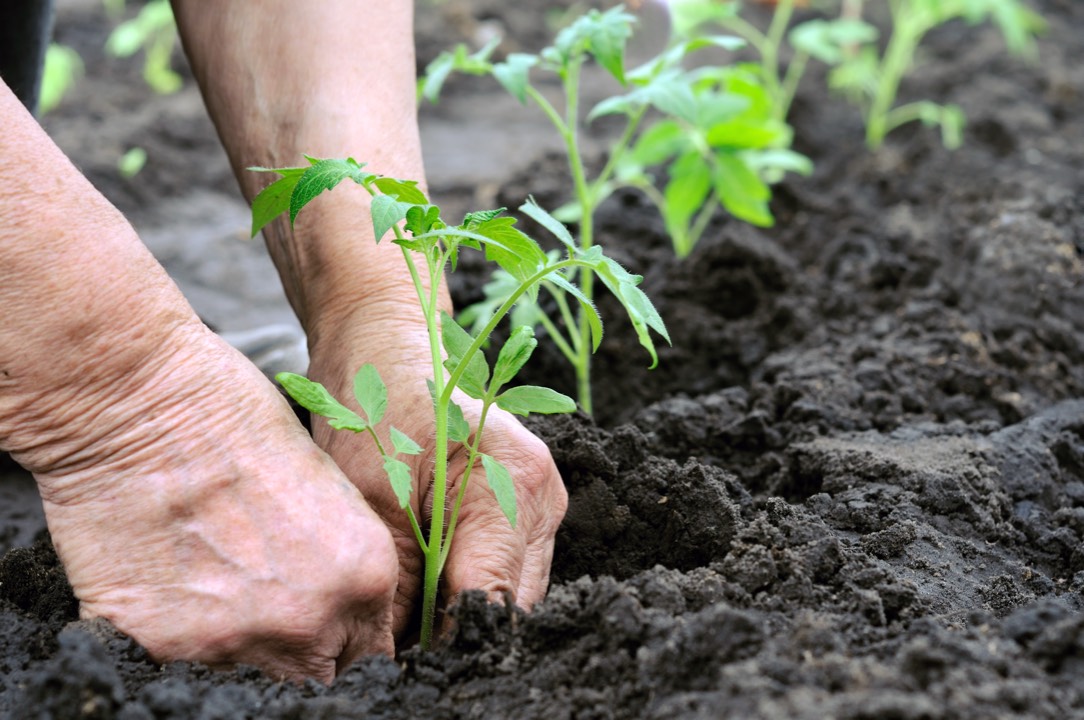
It’s time to plant tomatoes outside about two weeks after your average last frost, once the soil is warmer than 60°F. For most of Utah County and the Wasatch Front, that means between May 15 and June 1, depending on where your yard sits. Every year, I put one or two plants out earlier than the suggested time, and every year those plants don’t do as well as the ones that wait until it’s warmer.
If you’re starting them as seeds (and I recommend you do!), start them indoors 6 to 8 weeks before your planting-out date.
| Where you garden | Average last frost | Plant tomatoes out | Start seeds indoors |
|---|---|---|---|
| Salt Lake (airport) | April 26 | May 15 | March 20 – April 3 |
| Utah County, early zone: Provo and Orem benches, Pleasant Grove, American Fork, Alpine, Highland | May 1 | May 20 | March 25 – April 8 |
| Ogden, Logan (USU campus) | May 3 – May 7 | May 20 | March 25 – April 8 |
| Utah County, middle zone: Lehi, Saratoga Springs, Spanish Fork, Salem, Payson, Santaquin | May 14 | June 1 | April 6 – April 20 |
| Utah County, late zone: West Provo, Vineyard, low ground near the lake | May 21 | June 1 | April 6 – April 20 |
| St. George | March 30 | April 13 | February 16 – March 2 |
Your own yard can run a week earlier or later when compared to its weather station. Yards in the lower elevations near the lake and yards up in the canyons tend to frost later. Yards along the warmer benches, a little earlier.
Why tomatoes wait until after the last frost
Tomatoes (Solanum lycopersicum... note the sola in solanum, as in solar) are very tender, meaning a single frost kills them, and even chilly nights set them back. When nights drop below 50°F, plants often drop their flowers, and in cold soil the roots may barely grow. A tomato planted two weeks later into warm ground usually catches up with one planted early into cold dirt pretty quickly, and may produce more productively all season long.
That’s why tomatoes go out about two weeks after the average last frost, not on it. Summer squash and beans can go on the frost date; tomatoes, peppers, eggplant and melons should wait.
Starting seeds indoors
- Count back 6 to 8 weeks from your planting-out date. Seeds take one to two weeks to sprout, then five to seven weeks to grow into a good transplant.
- Keep them warm to sprout: soil between 65 and 85°F, then 65–70°F once they’re up.
- Give them lots of light: 14–16 hours a day, with grow lights just a few inches above the leaves.
- Harden them off over about two weeks before planting. Set them outside in a sheltered spot for a couple of hours at first, then a little longer each day, until they can stay out overnight.
A good transplant is stocky and dark green, 6–10 inches tall, with five to seven leaves.
Notes from My Garden
Tomatoes are another fruit that has endless varieties that don’t show up in the grocery store, to say nothing about the more intense flavor you’ll get from your home-grown crop. I’m infamous (among friends and family) for getting too excited about starting tomato plants and ending up with way too many seedlings. I get too eager to try new varieties and imagine the bounteous jars of tomato sauce that might come later.
Restraint is key. You will need enough seedlings to make up for the inevitable loss of a few starts, but not so many that you get tempted to overcrowd your beds when you transplant them out. Tomato plants can get really, really large, and I always try to squeeze too many in.
So keep that in mind when you’re starting your seeds!
Can I plant tomatoes earlier with protection?
Yes, you can get away with a few weeks by using hot caps, water-filled plant protectors like a Wall-of-Water, plastic tunnels or fabric row covers. But watch the heat on sunny days: open or vent covers once the air tops 80°F, because above 90°F under cover, flowers and young fruit drop.
How deep should I plant tomatoes?
Deeper than they came in the pot. Tomatoes grow roots along any buried stem, so burying a leggy plant up to its top few leaves gives it a bigger root system. In fact, some people plant their tomato starts horizontally, with just a small part of the seedling poking straight up out of the ground! Space plants about 2 feet apart, in rows 2 to 3 feet apart, and pinch off any flowers or fruit at planting. These are tempting to leave, but they’ll take energy from your plant and slow down the arrival of the real party.
When should I mulch tomatoes?
It depends on the mulch. Black plastic can go down before planting, since it warms the soil. Straw, grass clippings and other organic mulches keep soil cool, so wait until the soil is warmer than 75°F.
Why do my tomatoes have black, leathery bottoms?
That’s blossom-end rot, a calcium problem inside the fruit caused mostly by uneven watering. Water deeply and on a steady schedule, 1 to 2 inches a week, ideally by drip, and mulch to keep moisture even. Ironically, adding calcium rarely helps. This is an issue about getting the calcium where it needs to go, not necessarily a lack of available calcium.
Common mistakes
- Planting on the last-frost date. Tomatoes want two more weeks.
- Starting seeds in February (outside St. George). You’ll get leggy, root-bound plants by May.
- Mulching with straw too soon. It keeps the soil cold just when tomatoes need warmth.
- Too much nitrogen. Lots of leaves, few tomatoes. Two light side-dressings, at four and eight weeks after planting, are enough.